Project
Overview
Plant phenology provides the most direct evidence of the impacts of climate change on terrestrial ecosystems. The long-term phenological series compiled from ground-based observation networks reveal asynchronous patterns of interspecific phenology in response to climate change across different temporal and spatial scales. However, observation sites include specific urban areas such as botanical gardens and parks, and microclimate changes caused by urban heat island effects and other anthropogenic disturbances complicate the analysis of wild plant phenological responses to climate change under natural conditions.
Wildlife cameras are widely used to provide non-invasive, low-cost, and high-frequency observations of wildlife spatio-temporal distributions, activity patterns, abundance, interactions, and behaviors. Compiled statistics from Wildlife Insights, Agouti, TRAPPER, and Sino BON-Mammals suggest that conservation initiatives over the past two decades have yielded several million camera deployments, while the actual number is likely far higher due to incomplete reporting and uneven data coverage. Although wildlife cameras were primarily designed to capture animal observations in motion-triggered mode, their time-triggered mode can also be used to capture daily image series of vegetation, recording dynamic changes in species within animal habitats, such as budburst, leaf unfolding, flowering, and leaf senescence. Therefore, the global wildlife camera network has unintentionally become the largest, most widespread, and ecologically representative plant phenology monitoring system, providing vital insights into habitat dynamics, seasonal forage availability, and ecosystem conditions that shape animal behavior and population resilience.
Workflow
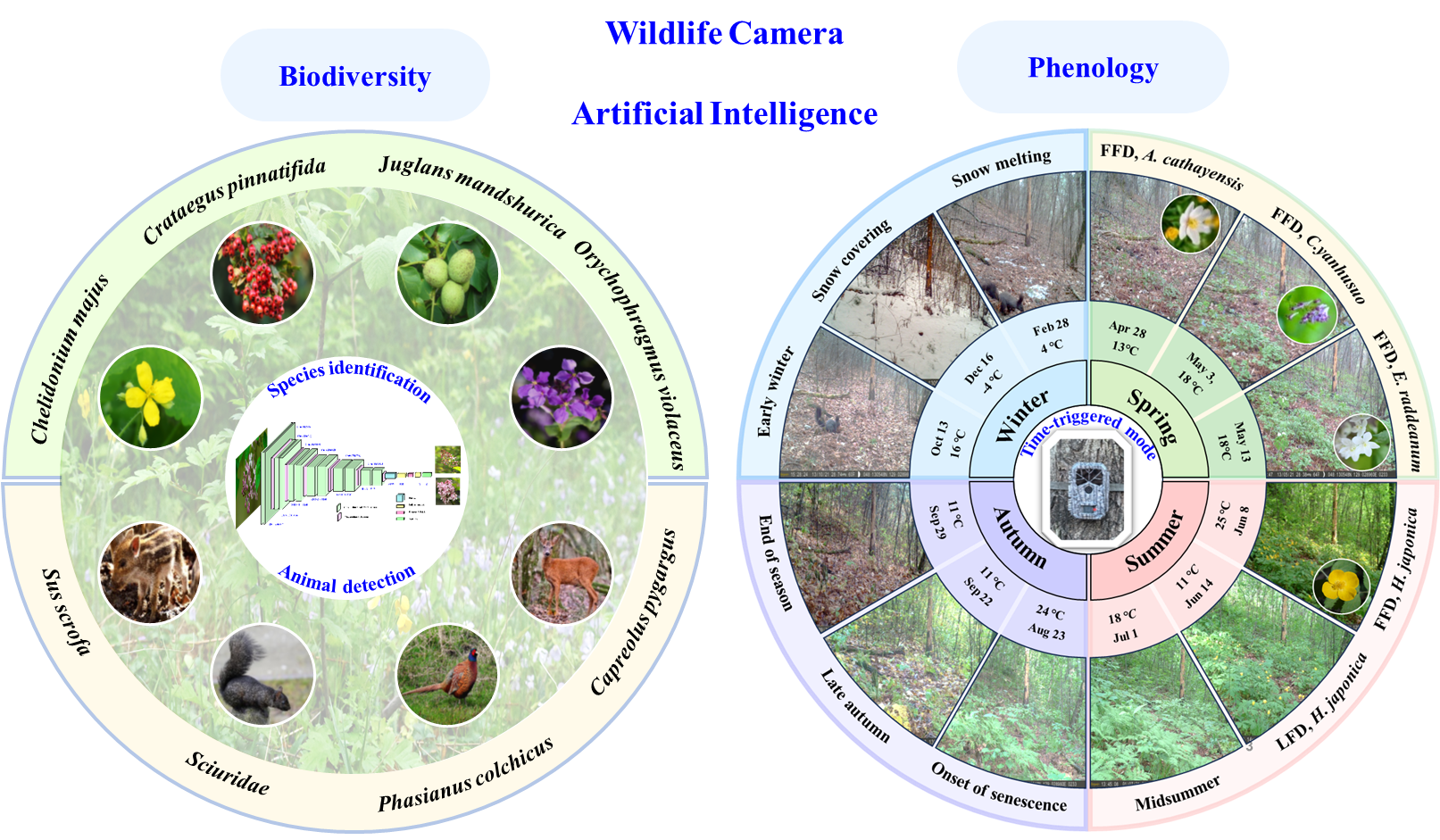
Key Features
- AI-Powered
- Plant Image Enhancement & Preprocessing
Built-in tools for improving image quality, filtering, and batch processing of diverse camera-trap imagery. - Semi-Supervised Automatic Annotation
Self-developed tool for foreground extraction in complex backgrounds and precise labeling of individual plants. - Individual Plant Instance Segmentation
Advanced deep learning models to isolate and track individual plants from cluttered wildlife-camera scenes. - Automated Phenological Data Extraction
Deep learning–driven detection of key events: bud break, flowering, fruiting, and senescence from time-series imagery. - Standardized Data Processing
End-to-end workflow — from raw camera-trap images to analysis-ready, FAIR-compliant phenological datasets.
Ecological Significance
Terrestrial ecosystem seasonal phenological rhythms regulate carbon, water, and energy fluxes, shape reproductive success, structure trophic interactions and cascades, and ultimately influence the stability of ecosystem structure and function.
PhenoTrap not only fills a significant gap in the long-term monitoring of natural ecosystems in numerous nature reserves, but it will also provide accurate ground-based validation data for satellite phenological products. Most importantly, it unlocks unprecedented insights into wildlife behavior, migration, species, and population size, revealing the fine-grained spatial and temporal patterns in biodiversity, changes in species spatial migration, and interactions between plants and animals, thereby delivering crucial evidence for wildlife conservation policy.
Additionally, PhenoTrap images offer a potential alternative method for acquiring various meteorological variables such as sunshine, hail, and snow cover, and may provide effective information for other natural disasters such as insect outbreaks, wildfires, and frost.
Long-term monitoring of plants and wildlife in the same habitat can reveal the asynchrony in species interactions caused by climate change, thereby enabling the exploration of trophic cascade effects in ecosystems and the mismatch of phenological events at different trophic levels on a global scale.